
Primary School 10/30
Happy Halloween!
Before we send you our general election preview, we’re sending you one last update, because there’s been a lot of movement in some of the big nonpartisan and Dem-vs.-Dem races on the ballot this November. We have to start with Los Angeles, where a scandal over racist comments made by high-ranking city leaders and a veritable tsunami of money from a self-funding billionaire have made an already chaotic election cycle even more so.
Los Angeles
LA: Let’s stick the landing.
The summer primary ended without any outright victories in most of the big races, setting up nearly a dozen high-stakes runoffs in November.
The highest-profile of these is the contest for Mayor, and it’s the contest where the least has happened since June, when Rep. Karen Bass led anti-abortion real estate billionaire and recent Republican Rick Caruso 43% to 36%. The most important update is that runoff polling is finally available, and there has been some tightening. Berkeley IGS, who nailed the primary by releasing a Bass+6 poll (38% - 32%) a week before the election resulted in a Bass+7 first round victory, first had Bass winning the runoff in their August poll by 21% (53% - 32%), and then winning in their September poll again, but by 13% (46% - 31%). Also in that time, Global Strategy Group and Probolsky Research both found 6% margins in favor of Bass. However, all of those polls are at least a month old by this point, and the only poll released in October is one by J. Wallin Opinion Research, which primarily isn’t an electoral pollster, or at least doesn’t usually release their electoral polls to the public. The most recent we could find was from 2018, but at least it was pretty accurate. They found Caruso leading 40% to 37%. Polling underestimated Bass in the first round, but that may have been more because Caruso was dominating the airwaves far before she even began to air anything, and she peaked late, rather than because of any systematic issues with polling.
The City Attorney contest, between progressive civil rights attorney Faisal Gill and liberal, vaguely reformist prosecutor Hydee Feldstein Soto. Feldstein Soto has, expectedly, leaned into Gill’s past as a Republican, which has created an odd campaign where he’s simultaneously being attacked for being too conservative because of that past, and too progressive, for his platform, including his plan to not prosecute most misdemeanors, something that Bass actually unendorsed him over. Still, the candidates have rarely attacked each other directly, leading to a quieter race, in contrast to the genuine hate Bass and Caruso seem to have for each other at this point. Gill has taken to self-funding over $1 million.
In the City Controller race, City Councilor Paul Koretz has been running scared since finishing behind ex-Green accountant Kenneth Mejia by a brutal 43% - 24% margin. Koretz has taken to throwing everything at the wall to see what sticks, from getting an ex-Controller to pen a letter about how dangerous Mejia is, to accusing Mejia of bringing a “band of anarchists” to City Hall during a vote on the city’s new homeless encampment sweeps law. Nothing really seems to have stuck, and Koretz being a long time councilmember can’t have helped him after the recent events…
Speaking of which, you’ve probably heard by now that the City Council is in a minor crisis at the moment, after audio tapes of a disgustingly racist conversation between three members—Nury Martinez, Kevin de Leon, and Gil Cedillo—leaked to the public. Nury Martinez resigned as president of the Council, and then from the body itself, while Kevin de León has defiantly remained in office. (Everyone’s sort of forgotten about Gil Cedillo, who’s going to be leaving office in a few months anyway thanks to his upset reelection loss in June’s first round at the hands of DSA-endorsed organizer Eunisses Hernandez.) The fallout is tainting the entire Council, but one of them is trying to use it to his advantage in reelection: Mitch O’Farrell, who is in the fight for his political life after finishing behind DSA-endorsed opponent Hugo Soto-Martínez 41% - 32% in the primary. O’Farrell is clumsily trying claim the mantle of anti-racist/anti-corruption fighter after manuvering his way into acting Council President following Martinez’s resignation. It’s an awkward fit, considering that reelecting O’Farrell over Soto-Martínez was one of the goals that the Councilors were talking about on the tapes, but if the media stays pliant, he may have a way forward.
Those tapes aren’t the only piece of Council drama, just the most exciting. Perhaps more impactful for actual election results is what’s happening in the open 15th district Council race, where the LA Times took the remarkable step of rescinding an endorsement. What initially looked like a quiet race between conservative Tim McOsker and more liberal Danielle Sandoval was given citywide attention after reports emerged of Sandoval engaging in rampant wage theft at a restaurant she ran. Sandoval has apologized, but it’s too little, too late for many progressive voter guides, and likely some progressive voters.
More explosive news has come out of the LA County Sheriff's runoff. Sheriff Alex Villaneuva, in dire electoral straits after taking just 31% of the first round vote as an incumbent, and trailing by a 36% - 26% margin to Eric Luna in the only publicly available poll of the runoff, ordered his deputies to raid the home of a county watchdog and longtime critic of his. Targeting your political enemies with police raids is tinpot dictator shit, but it’s not surprising from the leader of a department infamous for its storied and bloody tradition of deputy gangs—exactly like a regular street gang, except its members are sheriff’s deputies who engage in violent criminal activity, up to and including murder, under the protection of the LA County Sheriff’s Department. (Villanueva is an alleged member of one of the most notorious deputy gangs, the Banditos, based out of the East Los Angeles station where Villanueva got his start with the department in the late 80s; he has hired alleged Banditos and at least one confessed member of a different deputy gang, the Grim Reapers, to top posts in his administration. He has also engaged in a blatant scheme to obstruct investigations into deputy gangs.)
Q3 Congressional fundraising
Combined 3rd Quarter and Pre-General filings, covering 7/1-10/19
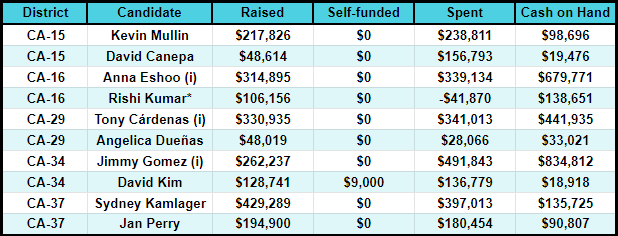
*Kumar did not file a Pre-General report, and, as such, only his 3rd Quarter filing is reflected here
This is surprisingly good for Kim and Dueñas relative to their usual fundraising paces, and surprisingly bad for Canepa. In 2020, Kim and Dueñas gave Reps. Gomez and Cárdenas a good scare on a budget of $5 and a prayer; while neither is especially well-funded now, they’re both fundraising at a better pace than ever before. Canepa is headed in the opposite direction, with his fundraising collapsing after a lackluster primary performance. It’s tempting to chalk Dueñas and Kim’s surge up to the effects of the Los Angeles City Council scandal—both Gomez and Cárdenas are avatars of the same Los Angeles establishment that produced Nury Martinez, Kevin de León, and Gil Cedillo, and Martinez is Cárdenas’s protégé, having succeeded him on the city council upon his initial election to Congress in 2012. But the recordings only leaked in mid-October, too late to be responsible for the uptick.
CA-15
Ever since Assemb. Kevin Mullin cruised to a 41-24 first round showing in this Bay Area district, we assumed this election was over in November and his opponent, San Mateo County Supervisor David Canepa, would be lucky to hit even a third of the vote. We still think that, especially considering Canepa’s aforementioned fundraising nosedive, but it does make the late spending here by AIPAC all the stranger. In early October, as ballots went out in California, AIPAC spent $78,000 on a digital ad supporting Mullin, a sum that has by now increased to $379,000. Web3 Forward, the cryptocurrency-focused PAC funded by millions from FTX billionaire Sam Bankman-Fried (and friends) also threw in a $100,000 ad buy.
DC Council At-Large
The District of Columbia elects two at-large Councilmembers every cycle, and the city's policy of not allowing both to be from the same party creates one de jure Democratic primary in the summer and one de facto Democratic primary in the fall, as a handful of Democrats running as independents compete for an electorate that has mostly tuned out politics after the primary functionally decided every other important election. The incumbent independent this cycle is Elissa Silverman, a member of the Council's progressive faction. Normally, she wouldn't have much to worry about, but this year the Council race picked up a high-profile last minute entrant: District 5 Councilmember Kenyan McDuffie, fresh off of getting thrown off the Democratic primary ballot in the DC Attorney General race over the minor issue of not being a practicing attorney, which is a legal requirement to run for DC AG. McDuffie has picked up several late endorsements from centrist leaders in DC: The Washington Post (in the same editorial they also endorsed a Republican for Council, naturally), Council Chair Phil Mendelson, Tom Perez (in case any Wes Moore voters wanted to feel better about their choice), and urbanist web magazine Greater Greater Washington, which had already beclowned itself with an endorsement of Mayor Muriel Bowser in the Democratic primary that read like the transcript of a hostage video.
A third candidate, Graham McLaughlin, has emerged in prominence thanks to good fundraising and landing the other Washington Post endorsement, but he isn't expected to draw much support outside of some wealthy white neighborhoods in the city's west. Silverman is evidently worried that means he'll be eating into her voters (for better or for worse, McDuffie has strong support among the city's Black political leaders, while Silverman has done best in white and Hispanic parts of the city), and recently accepted an endorsement from Karl Racine, the city's outgoing AG, in one of those rich white neighborhoods that McLaughlin is expected to have a pulse in. Silverman has also put herself in danger by paying for, out of government funds, a poll clearly not intended to help her campaign. At-Large Councilor Anita Bonds, the only candidate listed on the ballot as a Democrat, is a strong favorite for another term just by virtue of having the Democratic ballot line, but Bonds is the epitome of a checked-out, lazy local politician who expects to coast without any effort. Silverman, McDuffie, McLaughlin, and progressive first-time candidate Karim Marshall are all running vigorous campaigns, so while it may be quite unlikely for Bonds to fall out of the top two and thus lose her seat on the council, it’s not impossible. The Washington Teachers’ Union, which leans progressive, is backing Silverman and Marshall, snubbing Silverman’s fellow incumbents McDuffie and Bonds.
Hennepin County, MN County Attorney
Martha Holton Dimick, the tough-on-crime prosecutor supported by Minneapolis Mayor Jacob Frey but elevated into the runoff by the suburbs, may not have been eligible for the ballot in the first place. Though it's almost certainly too late to bring any legal challenge to her candidacy, the law license Dimick used to file her candidacy had expired in 2019. Though the campaign initially tried to pass it off as her simply handing the clerk the wrong card when she was filing, the full story is murkier; the evidence seemingly points to her trying to save money by deactivating her license, and then only fessing up to it when caught—an explanation that makes more sense, but still not that much.
Phoenix City Council
The first round of the nonpartisan Council elections happens concurrent to the November general elections, with runoffs in March should no one receive a majority of the vote. While districts 2 and 4 are sleepers, 6 and 8 are important, crowded races. It’s recently been reported that Kate Gallego, the city’s centrist, nominally Democratic mayor, has been frustrated by a 5-3 Democratic majority, and is trying to get at least one of these two seats to flip to one of her allies, ending the progressive majority. In District 8, covering the city’s downtown, it’s no secret she just wants incumbent Carlos Garcia, who has been a leader on police reform, gone, but while Kesha Hodge Washington is the establishment’s choice to do that, Gallego hasn’t officially endorsed anyone. In open, suburban-ish District 6, Gallego is more openly pushing for cop Kevin Robinson, while progressives, including Garcia, want union representative Kellen Wilson.
Portland City Commissioner
Jo Ann Hardesty might be the latest victim of the post-George Floyd reactionary backlash hitting Portland. Hardesty, the last leftist remaining in city government, has drawn the ire of conservative interests in the city, who, in the final stretch of the race, have unleashed a negative spending blitz of over $200,000 against her in the runoff, where she faces wealthy business owner Rene Gonzalez. Portlanders, more than the residents of just about every big city in America, have an extremely negative opinion of how their city government is functioning, and Hardesty is caught in the crossfire despite being involved in, let alone responsible for, very few of the city government's decisions. Oregon Live has funded two polls of the race, one in mid September and the other earlier this month. The former found Hardesty down 26% to 50% and the latter showed her losing by a similarly crushing 49% to 22% margin. Considering she earned 44% of the vote in the first round this spring, it's unlikely things are quite that bad for her, but no one's acting like she's leading.
St. Louis City Aldermanic President
Lewis Reed resigned his position running the Board of Alders after badly fumbling a mayoral bid last year and subsequently getting indicted on corruaption charges, forcing a surprise special election for the city’s second most powerful office. Progressives quickly settled on DSA-affiliated Ald. Megan Green, who narrowly lost the Aldermanic President primary to Reed in 2019, while Team Moderate dithered for a while before finally landing on Ald. Jack Coatar. A quirk of the city’s new electoral system requires all elections, even specials between two candidates, to take two rounds. The first happened in mid-September, and to the surprise of many, Green received about 54% of the votes, to 46% for Coatar. While turnout was a rock-bottom 6%, a distinct pattern of the vote still emerged. Green won the predominantly Black north of the city, and the more progressive white wards as well. In higher-turnout elections, that combination is unbeatable, which explains why business interests are suddenly freaking out and dumping money into Coatar’s campaign. The St. Louis Post-Dispatch, the city’s largest newspaper, endorsed Coatar this week. (The St. Louis American, the city’s main Black-focused newspaper, endorsed Green back in September.)