

Coronavirus Corner
New Jersey has postponed its primaries until July 7 in response to the coronavirus; New Jersey is having the second-worst outbreak in the nation, with only New York faring worse. This affects NJ-05, NJ-09, NJ-Sen, and various local primaries of interest.
MA-all
Massachusetts candidates hoping to make the ballot for the state and federal primaries on September 1st only have until May 5th to gather petition signatures, and the state government has not taken any action to lower signature requirements in light of COVID-19. Signature collecting normally requires a ton of person-to-person contact — knocking doors of registered Democrats, standing around with a clipboard at high-traffic areas asking strangers to sign — in other words, not conducive to social distancing.
Three candidates, including two Democratic primary challengers (Robbie Goldstein, running in MA-08 and Melissa Bower Smith, running in MA-HD-4th Norfolk), have filed a petition with the Supreme Judicial Court arguing that it’s unconstitutional to enforce state election laws during this public health crisis. Legislation has been introduced in the state legislature to decrease signature requirements, but even though it’s been endorsed by heads of both the Massachusetts Democratic and Republican parties, the bill is stuck in committee. As per usual, shitty incumbents are only looking out for themselves.
On the other hand, Sen. Ed Markey, an actual good incumbent, has been struggling to reach the required 10,000 signatures. Campaigns like to get significantly more signatures than the required number because many signatures end up being invalid. Basically, barring some legal action on the part of the courts or state legislature in the next couple weeks, Markey’s current count of around 7,000 signatures definitely won’t cut it. Joe Kennedy, on the other hand, has already filed over 15,000. Markey’s team is working hard to get the remaining signatures through remote organizing tactics, but the coronavirus has definitely hindered their petitioning efforts. Any readers registered to vote in Massachusetts should consider filling out this form pledging to sign Markey’s petition ASAP and help him get on the ballot.
Fundraising Roundup
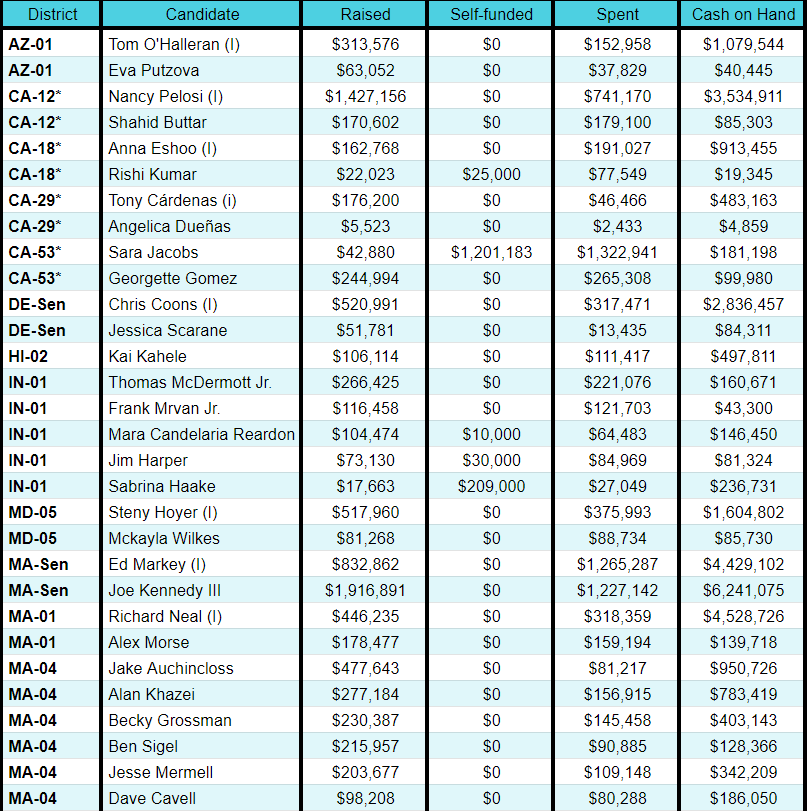
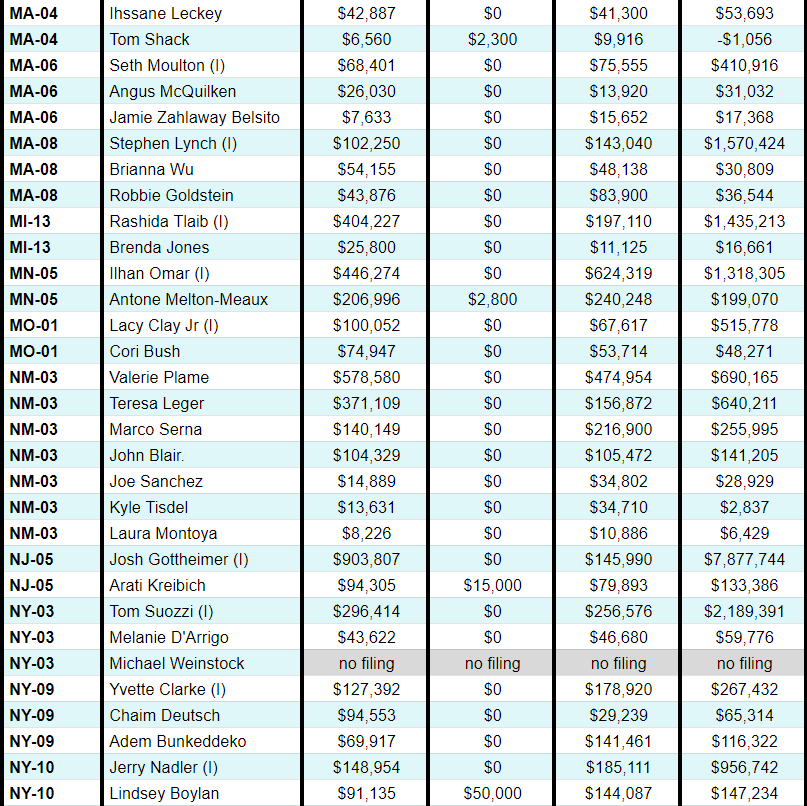
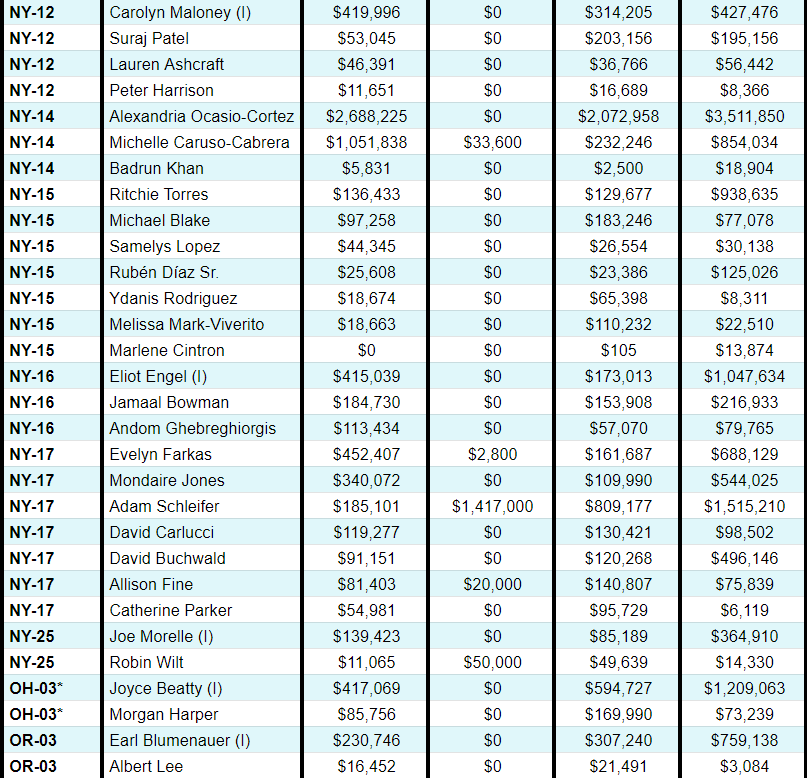
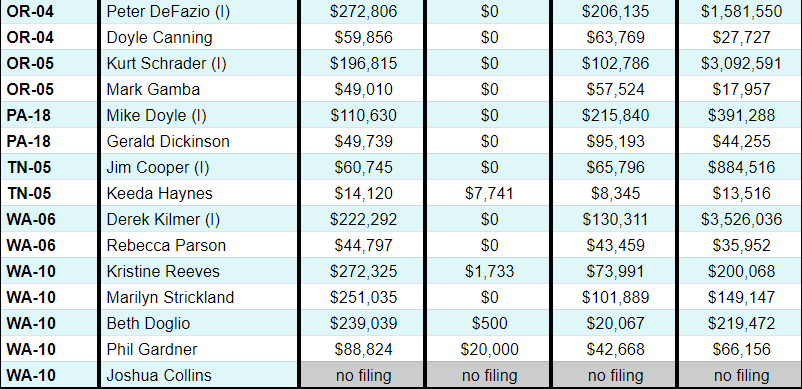
AZ-01: This is the best quarter Putzova has had to date, almost twice her previous best. $63,000 still isn’t great of course, but when you’re talking about the minimum viable product for a campaign, that’s a lot more like it than $30,000. For instance, she hired a field director in January. Especially impressive was that she grew her fundraising while most progressive campaigns took a coronavirus-related hit.
*Note for the California races - these filings include about half the first quarter of the year, 2/13-3/31. The first half of the quarter, 1/1-2/12, was already reported
CA-12: Primary elections aren’t decisive, however they tend to be predictive, and Pelosi’s 75% of the primary vote suggests there’s just not a lot of anti-Pelosi vote to coalesce in the general election. But there’s enough anti-Pelosi sentiment nationally for good money numbers from Buttar
CA-18: Kumar’s fundraising continues to be middling, and he’s bailing himself out with a bit more self-funding. Mostly a status quo quarter.
CA-29: We haven’t mentioned this race before now. Angelica Dueñas, a local activist and previous Green Party candidate for this seat managed to earn an impressive 22% in the open primary for this seat, placing her in the runoff with sub-mediocre incumbent Tony Cárdenas in this Los Angeles-based seat. Dueñas spent almost nothing in the primary, and it looks like that will continue into the general election. Cárdenas got only 59% of the vote in the primary, his worst showing ever. Cárdenas previously faced a Democrat in the general election once before, in 2016, when he beat Los Angeles City Councilmember Richard Alarcon 75-25. But Cárdenas won that primary 61-13, better than his 59-22 showing this year. This race may wind up not being a blowout if Cárdenas decides against any active campaigning once again.
CA-53: Those are good numbers from Gomez, who propelled herself to a 29-20 second place finish in the open primary. The real eye-bulging numbers here are from Jacobs, whose seven figure self funding can be taken as a statement of intent for how hard this child of billionaires is planning on turning the money cannon up
HI-02: Kai Kahele is still the only candidate in this race, and he starts at a large advantage with his months of campaigning that have already occured. It seems like the Hawaii political world has gotten word that he’ll be the only candidate in the race, seeing as he’s fundraising more like an incumbent, and he recently got the endorsements of Senator Brian Schatz and Congressman Ed Case
IN-01: God what a mess. Hammond Mayor Thomas McDermott, the only person in the district who thought incumbent Peter Visclosky deserved a primary challenge from the the right is pulling in the most money, with everything else a jumble. The UAW and Visclosky endorsements obviously helped mediocre white guy Frank Mrvan connect with donors, while progressive Jim Harper padded a slump of a quarter with self-funding and pretty-solid-liberal-but-not-quite-as-good-as-Harper state rep. Mara Candelaria Reardon had another eh haul. There’s a bit of a wildcard in Sabrina Haake however, whose self-funding surprised us.
MD-05: This isn’t quite the showstopping breakout quarter that we were hoping for from Mckayla Wilkes, but it is a huge improvement, and considering how brutal this quarter was for a lot of campaigns, pretty damn good and coming at the right time. Wilkes recently released a 3 minute ad/re-introduction video, which went semi-viral on twitter. It’s a very strong ad, will probably lead to more donations and word of mouth, and was likely only possible to make without endangering the finances of the campaign because of her good Q1. It’s illustrative of the positive feedback loop that a grassroots campaign can create from raising some seed money.
MA-Sen: covered last week
MA-01: Income-wise, this isn’t terrible for Morse, but expense-wise, woof. This isn’t disastrous, just the result of sticking to a campaign plan which was premised on more income. Morse will probably have to make his campaign leaner going forward if he doesn’t want to walk into election day without much on hand
MA-04: This race has shaken out to be: Jake Auchincloss, centrist boy wonder and money machine raising incredible amounts of money; Ihssane Leckey the socialist grassroots candidate raising what is unfortunately a very grassroots amount of money, and then a chunk of 4 more typical candidates in the 200Ks range. There’s also Obama speechwriter Dave Cavell, who doesn’t have the grassroots appeal of Leckey, the political connections of half the field, or much money. His personal appearances are also pretty meh. Watch us eat shit on this one, but it seems like he’s the only candidate without a real shot at winning. Well, him and former state Comptroller Tom Shack, who - what is he even doing?
MA-06: Zahlaway Belsito and McQuilken did about as well as last quarter, no real surprises there. But wow, Moulton’s just not fundraising after he found out that no one would care if he ran for president, huh?
MA-08: Ugh, looks like Robbie Goldstein, who came out of the gate strong, didn’t have a lot of fundraising ability outside of his initial connections. This drops us back into the situation we were scared of, where a conservative incumbent faces two progressive challengers, neither of whom clearly pulls ahead, leaving a basically guarenteed path to re-election. A 1 v 1 with Wu was probably also a guaranteed win for Lynch, considering his decisive 71-23 win over her in 2018. We were hoping Goldstein could seriously shake things up, but that’s looking doubtful, especially now that COVID-19 has placed a larger price tag on voter contact
MI-13: See MI-13 item
MN-05: Yes, Ilhan Omar has a primary challenger, and yes he’s raising a lot of money from the animosity she generated from some conservatives and centrists. No, we don’t think she’s in much actual danger.
MO-01: This is about the same as last quarter, except with even weaker numbers from Clay, who should be able to do much better than this as an incumbent. Bush continues to be stronger than last cycle, which was a 57-37 Clay win - closer than most people predicted, but not necessarily “close”.
NM-03: This race increasingly looks like a contest between Leger, who has support among a lot of party activists and local groups, and Plame, who’s got buckets and buckets of money. At the very least, Sanchez, Montoya, and Tisdel have roughly no money, an unfortunate situation for the final months of a campaign. And Marco Serna, who had an okay quarter, just ran into more ugly, self-induced headlines
NY-03: Another status quo quarter here, although D’Arrigo has had a small increase over her last quarters.
NY-09: Both candidates here had a rough quarter, but it was far worse for Bunkadekko, who raised less than $70,000 and spent more than twice that. He’s lucky that he has name recognition from 2018 and an opponent who also doesn’t have a lot of money. He’s also lucky, in a way, for Chaim Deutsch, the very conservative City Councilor who is taking this race a lot more seriously than we thought, and raised nearly $100,000
NY-10: Lindsay Boylan, like a lot of challengers, faced a fundraising slump. Unlike most progressive challengers however, she had the personal funds to patch up the gap. Nadler
NY-12: Despite a lot - a lot - of missteps in 2018, Suraj Patel could do one thing well that year: fundraising. He appears to have lost his ability this time around, because woof. Lauren Ashcraft, perhaps benefiting from the exit of Erica Vladimer, had a semi-decent showing this time around.
NY-14: Oh Jesus Christ. A million actual dollars went to Caruso-Cabrera’s quixotic campaign. Ocasio-Cortez
NY-15: So, uh, is Marlene Cintron still running? She raised literally no money. Melissa Mark-Viverito’s fundraising has also slowed to a near halt, and she’s down to basically no reserves. Everyone's fundraising has slowed down, really, except late entrant and grassroots favorite Samelys López, who likely benefited from Alexandria Ocasio-Cortez’s endorsement. Torres’s fundraising drop is probably because he has so much in the bank he’s going to be okay to run on reserves from now on, but Michael Blake and Ydanis Rodriguez are going to be hurting soon if things don’t change. And Diaz Sr is still doing his thing, we guess.
NY-16: See item
NY-17: Mondaire Jones continues to have the strongest organic fundraising in the field, but he will be greatly outspent it seems, after billionaire’s kid Adam Schliefer has dumped a million and half into his race in this quarter alone. Carlucci, Buchwald, and Fine are doing well enough to stay in the race, but Catherine Parker is flat broke. The race remains wide open.
NY-25: Looks like Rochester City Councilor Robin Wilt is mostly going to self-fund this race. If she’s going to do that, though, she’ll need more than $50,000.
*Note for the California races - these filings include about half the first quarter of the year, 2/26-3/31. The first half of the quarter, 1/1-2/26, was already reported
OH-03: Poor Morgan Harper. She spent everything in anticipation of a primary which was delayed the night before. She’s recovering well enough, but her reserves are low as hell now.
OR-03: Albert Lee, after showing some fundraising promise last quarter, is back to bringing in very little
OR-04: Pretty good quarter for Canning. Otherwise, nothing too exciting
OR-05: Both candidates did about as well as last quarter. Gamba is still in the race but painfully short on funds
PA-18: Gerald Dickinson puts in another mediocre quarter, his third after a strong start in Q2 2019. But his expenses, again likely in anticipation of a primary that was moved later, were more than twice his intake, leaving him, like many challengers, dangerously short on funds
TN-05: Public defender Keeda Haynes, while the favorite of many local activists, couldn’t put together much to start her campaign with
WA-06: Parson had another typical quarter, as did Kilmer, who is, as of yet, not tapping into his immense reserves to invest in the primary
WA-10: State Rep. Kristine Reeves, Amazon flunky Marilyn Strickland, and state Rep. Beth Doglio all did roughly as well this quarter, but former Denny Heck district director Phil Gardner, who starts without the name recognition of those three, raised far less and hopefully won’t be too much of a factor in this race. Joshua Collins hasn’t filed his report yet, which is a shame, since we were really curious how he’d do in his first quarter where he wasn’t challenging an incumbent.
Incumbent Challenges
GA-HD-91
Corrupt Democratic State Representative Vernon Jones came out and endorsed Donald Trump for President this week. This endorsement isn’t too much of a shock, though, as Jones has had his fair share of scandal and general legislative crappiness over the years. Just when he was DeKalb County CEO in the early 2000s, Jones found himself accused of rape, bid-rigging, and theft. Now as a state representative, Jones has spent his time retweeting positive articles about Trump and working with Republicans on legislation encorage harassment of undocumented immigrants. Upon hearing about Jones’ endorsement of Trump, Jones’ Democratic colleague, Rep. Scott Holcomb said, “They’re both incompetent narcissists. This isn’t surprising.”
Thankfully, Jones already has a primary challenger this year, community activist Rhonda Taylor. Taylor also challenged Jones in 2016 and lost with 46% of the vote in a runoff after placing second in a race with four candidates. This time, though, Taylor has the support of the entire Georgia House Democratic leadership — even they are pretty angry about Jones’ endorsement. Taylor’s website is vague on the issues, but her bio does give off big feminist vibes. Having a liberal Democrat in this seat would definitely be a step up from Jones the DINO.
MI-13
A poll released earlier this month showed challenger Brenda Jones has closed the double digit gap between her and Rashida Tlaib to just nine points, trailing at 34% to Tlaib’s 43%. This is a huge gain for Jones, especially since she only announced her bid for Congress three weeks ago. Jones did particularly well in Detroit, where she has greater name recognition as president of the City Council, and better with male voters. Tlaib’s strong support outside of Detroit and national fundraising strength makes her favored right now, but if Jones builds support outside of the city, she could become a real threat. For now, however, Tlaib’s favorability ratings are over 10 points higher than Jones’, and the pandemic makes it difficult for anyone without a national profile to fundraise effectively. Jones’s attempts to fundraise in her campaign’s first week was more of a wimper than a bang, while Tlaib has nearly 1.5 million in her campaign account
In other news, Jones tested positive for coronavirus two weeks ago and has been isolating since. It doesn’t appear that she has a severe case, however, so this likely won’t change the state of the race.
NY-16
Andom Ghebreghiorgis’s campaign has been in danger of serving as a spoiler by splitting the progressive vote for a while now; last week, in a development we missed at the time, he allegedly took it to a new level. According to a statement from minor candidate Chris Fink, Ghebreghiorgis filed challenges to all of his opponents--not just Fink, but also Rep. Eliot Engel and main progressive challenger Jamaal Bowman. Ghebreghiorgis, Fink says, is challenging the ballot petitions of all of his opponents, saying that the overwhelming majority of all signatures for other candidates are illegible. If Ghebreghiorgis does not withdraw his challenges, election workers will have to physically examine thousands of petitions.
During a pandemic, this is, obviously, quite dangerous, especially in New York City and Westchester County, which lie at the center of America’s worst COVID-19 outbreak. Petition challenges are a normal, if underhanded, part of politics in most circumstances; during a pandemic, they’re dangerous. Normally, we’d at least welcome the challenge to Engel; if nothing else, things like petition challenges keep political machines from getting complacent. However, under the present circumstances, any challenges are irresponsible and a danger to public health.
This quarter was one of the best for Engel’s in a while, both because of his uncharacteristically large intake, but also because both of his opponents did fairly well despite the tough circumstances, raising the likelihood of a split field that could allow Engel to win with far from a majority of the vote.
TN-HD-90
This week, Tennessee Democrats used an anti-democratic measure to get rid of their most troublesome conservative lawmaker. That lawmaker, state Rep. John DeBerry, was only nominally a Democrat; while DeBerry generally stuck with Democrats on budget votes, he abandoned the party on school vouchers, abortion, and even the speakership of the state house. It’s that last one that cost him; DeBerry has been conservative on, well, everything throughout his decades in the state house, but breaching party loyalty was too much for state Democrats.
According to a complaint filed against DeBerry with the state Democratic Party, which has been shared with Primaries for Progress, DeBerry didn’t just vote for Republican speaker candidate Glen Casada (since disgraced and forced by his own party to resign in the wake of scandals relating to his chief of staff’s racism, misogyny, cocaine use, and apparent attempts to frame an activist for a crime he did not commit, as well as Casada’s own misogyny and his meddling in an ethics investigation.) DeBerry also, according to the complaint, accepted donations from prominent Republican individuals and PACs; in 2016, he even donated to controversial Republican state Rep. Bill Sanderson, who resigned in 2019 amidst allegations that he used Grindr to meet up with much younger men. (Sanderson, naturally, had an extremely anti-LGBT voting record.)
Tennessee’s ballot laws contain a unique provision, normally used to get rid of primary challengers, allowing the state party’s executive committee to remove candidates from the primary ballot. The provision is rarely used against incumbents; the two most recent times it’s been used against incumbents, in 2008 by Democrats and 2009 by Republicans, were also in retaliation for the incumbent breaking ranks with their party in a speakership vote. The state Democratic committee initially voted to kick DeBerry off the ballot last Thursday; yesterday, DeBerry’s appeal was also rejected by the committee.
According to the Tennessee Secretary of State, DeBerry’s only remaining option is to challenge the ballot removal process itself in court; since DeBerry is mulling running as an independent or Republican in 2022, he seems to have thrown in the towel on keeping his party affiliation, and Tennessee law prohibits him from running under another party’s banner this year. If he does try running with another party designation in 2022, it’ll be a very uphill battle; his Memphis district gave 83% of the vote to Hillary Clinton in 2016.
We’re not fans of the ability of a state party to remove duly qualified candidates from the ballot; however, we won’t miss John DeBerry.
Open Races
NM-03
Santa Fe District Attorney Marco Serna is being sued in federal court for alleged wage theft. Serna’s tenure as DA was already a weakness for him—he once botched a murder prosecution by taking so long to carry it out that a judge dismissed the charges on the grounds that the defendant’s right to a speedy trial had been violated—and this just adds fuel to the fire. Three current and former employees allege that under Serna, they were regularly denied federally mandated time-and-a-half overtime pay for hours they worked past 40 hours each week.
Serna is just one of many candidates for this open, safely Democratic seat covering Farmington, Santa Fe, Taos, Los Alamos, and rural northern New Mexico. Along with Serna, the leading candidates appear to be AOC-endorsed progressive attorney Teresa Leger Fernandez and weird ex-CIA agent/Bush administration throwback Valerie Plame, but a number of other notable candidates are in the race, including Deputy Secretary of State John Blair, Sandoval County Treasurer Laura Montoya, and state Rep. Joseph Sanchez.
NY-17
Mondaire Jones, who was running for this seat as a progressive primary challenger before House Appropriations Committee Chair Nita Lowey announced her retirement and who remains the best candidate in the race, rolled out a very long list of local endorsements this morning. Jones already has the New York WFP, Elizabeth Warren, Ayanna Pressley, and the UAW in his corner; with this slate of endorsements, he’s added the mayors of Irvington, Nyack, and Peekskill, three towns in this compact suburban district in New York’s northern suburbs, as well as a number of other local officials and activists. Notable among them are Peekskill councilmember Vanessa Agudelo, a DSA member, and former state Senate candidate Julie Goldberg, who nearly toppled literal Republican state Sen. David Carlucci in the 2018 Democratic primary. (Carlucci is now running in the Democratic primary for NY-17, sort of like one of those recurring nightmares you get.)

In a DEEP BLUE district that contains Olympia, the state capital, WA 10 is an OPEN seat. Over the upcoming decades, progressives NOW have a chance to win this seat. Check out a Progressive and make a donation: Rep. Beth Doglio, who resides in the district (unlike her 2 main opponents). She is a former NARAL activist, the director of Climate Solutions, a fantastic organization fighting climate change, and a state legislator who has had the backing of labor, teachers, and others. https://geometrydashmeltdown.com
WA 10 is an OPEN seat in a DEEP BLUE district, that includes the state capitol, Olympia. Progressives NOW have a chance to win this seat for the coming decades. Check out & contribute to a Progressive: Beth Doglio, a State Rep who LIVES in the District (unlike her 2 main opponents). She's a former NARAL organizer, currently leads a great climate change org, Climate Solutions, and has been supported by labor, teachers, etc as a state legislator.