
Issue #56
Folks,,, we gottem

OUR GIRL MARIE! SHE DID IT BABY!
We’re probably not the first people to tell you, but in case you haven’t heard: we got the bastard. Dan Lipinski went down to Marie Newman last night in a nailbiter. While a couple precincts are still out and a handful of late mail-in ballots are going to be counted later, we already have our winner.
Marie Newman 47.1%
Dan Lipinski 44.3%
Rush Darwish 5.9%
Charles Hughes 2.3%
It wasn’t a blowout in the end, but a win is a win, and considering that as an incumbent Lipinski only managed to pull 44% of the vote, Newman probably would have won by even more if this year had been a head-to-head rematch. Charles Hughes, like we suspected, wound up being a total nonfactor. Darwish did a little better, and considering how close the race was, that 6% may have tipped the scales to Lipinski if things had been a little different, but his campaign wound up as another proof that money can’t buy you love. Despite spending over $700,000 on this race, Darwish only received 6,001 votes.
The coalitions in this race looked similar to 2018, but there were key differences that allowed Newman to win. This district contains three main subdivisions: The City of Chicago, suburban Cook County, and Will County. It also contains a sliver of DuPage County, but that casts about 150 votes, and is pretty irrelevant for our purposes. Will County is the smallest portion of the district outside of DuPage - only 8-10% of Democratic votes - and was Newman’s best in 2018. She won it by 17.4% in 2018. She beat Lipinski by a tighter 3.4% in suburban Cook, and then took a heavy 12.8% loss in Chicago. Take a look at what changed since then
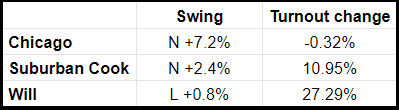
Newman actually did *worse* in her previous best county, Will, winning it 54.2 - 37.6. But she wound up netting 271 more votes from it, because suburban turnout was much higher, a trend that also carries through in Suburban Cook. In suburban Cook she did exactly what she needed to, 2.4% better than 2018, where she lost by 2.25%. Both of those changes from 2018 are in line with what would have been an almost tied race. It was in Chicago, the heart of Lipinski strength, where she won this race. Even though turnout was flat, she lost by much, much less, barely 5%.
Three possibilities jump out to us to explain this pattern. Most obvious is just a difference in campaigning. She was a suburban candidate who only gained prominence late in the race in 2018, and it’s possible she didn’t message to Chicago as well as she could have. It’s also possible that this speaks to a weakening of the Madigan machine. While Madigan used to be able to command huge vote totals for his favored candidates, he’s suffered some brutal losses lately, and with his federal investigation, maybe he just doesn’t have the punch he used to. Finally, this may be a result of a combination of higher Democratic turnout and lower Republican turnout. In 2018, there was a concerted effort by Republicans to vote in this primary, and they flipped the race to him. They would have been concentrated in Chicago, where there are fewer reasons to vote in the Republican primary. But this time around, Trump was on the ballot, so maybe they were motivated to vote for him instead of getting involved in a Democratic primary.
At any rate, we won this one, and it feels good. We beat Lipinski, and with him the Blue Dogs, the DCCC, the Problem Solvers, anti-choice groups, lobbyists, fracking and oil companies, and the multiple billionaires who all tried to prop him up.
Corona Corner
We’re going to give the advice you’ve heard a million times by now: stay safe, wash your hands, and if you absolutely need to get out of the house, try going on a hike or a bike ride instead of going somewhere with people. Above all else, listen to medical experts. The coronavirus has taken a wrecking ball though all aspects of American life, and elections are no different. (apply for a mail ballots ASAP if you can). A lot’s been changed already, and we’ll try to keep up with every new development.
Postponed races
Maryland postponed its consolidated presidential/downballot primary to June 2. This affects two primaries of interest, MD-05 and the MD-07 regular primary election, but not the April 28 MD-07 special general election, which will proceed as scheduled. Former Rep. Kweisi Mfume, who won the special primary in February, will easily win the special election to fill the remainder of the late Rep. Elijah Cummings’s term in MD-07, but will face Cummings’s widow Maya Rockeymoore Cummings and state Sen. Jill P. Carter in June for the full two-year term.
Ohio postponed its consolidated presidential/downballot primary to June 2, originally scheduled for today, at the last minute; this affects two primaries of interest, OH-03 and Hamilton County Sheriff.
Georgia postponed its presidential primary, scheduled for March 24, to May 19, when its downballot primary was already scheduled to be held; this affects GA-13, as well as a number of potentially interesting legislative and local elections, by guaranteeing the larger presidential primary electorate will also vote for downballot offices.
NY-all
New York Governor Andrew “mama’s boy” Cuomo announced a shortened petitioning window and lowered signature requirement for New York candidates hoping to qualify for the June 23rd state and congressional primaries. This change came in (extremely delayed) response to concerns about coronavirus and the amount of in-person contact required for collecting signatures. The petitioning window was originally supposed to last through April 2nd but ended up being closed this past Tuesday instead. As for the signature counts, Cuomo cut the requirements to either 1.5% of enrolled voters or 30% of the original threshold, whichever is lower.
While it’s great that Cuomo has finally decided to take public health seriously, even with the lower thresholds, the COVID-19 pandemic still poses a greater threat to grassroots and insurgent candidates hoping to make the ballot than it does to incumbents. Elected officials often collaborate with each other as well as party officials and local machine Democratic clubs for petitioning. Incumbents can leverage these connections to easily get the signatures they need with joint petitions, which allow someone to collect signatures for multiple candidates on a single petition. Insurgent candidates, on the other hand, tend to rely on individual volunteers and single petitions, which require more time and resources. We haven’t yet heard of any of the candidates we cover not getting enough signatures with the lowered threshold, but we imagine that certain campaigns at least struggled. We should know more conclusively after the filing deadline (whenever that is).
Queens Borough President
With early voting already underway, New York City Mayor Bill de Blasio announced on Sunday that the March 24th special election for Queens borough president would be postponed due to coronavirus concerns. De Blasio has not yet chosen a new date for the election, but New York politicos are speculating that he will likely consolidate the special with either the April 28th New York presidential primary or the state and congressional primaries on June 23rd. Because this announcement didn’t come until after the start of early voting, some ballots had already been cast. Those eager early voters will end up having to vote again, because their original votes are not getting counted.
Incumbent Challenges
MD-05
The big news in MD-05 is that the primary has been postponed. This is strategically good for challenger Mckayla Wilkes, whose campaign is just now ramping up. However, that’s not the only thing that’s happened this week.
Progressive Mckayla Wilkes got some very good news on Monday, with the endorsement of the progressive group Democracy for America. DFA can be a source of volunteers and donations, and it gives Wilkes some much-deserved media attention in her under-covered effort to topple House Majority Leader Steny Hoyer (though most of that will be drowned out by COVID-19.)
Hoyer is really, really bad, and he has a corrosive influence on the entire House Democratic caucus. He opposes the Green New Deal and Medicare for All, supported Social Security cuts, was wary of regulating Wall Street after the 2008 crash...just read our deep dive into his terrible career. Then, read our interview with Wilkes, to see what MD-05 could have instead of Steny Hoyer.
NY-03
Progressive activist Melanie D’Arrigo nabbed the endorsement of two activist groups this week. Yesterday, New York Communities for Change, a network of local activists, endorsed her, giving her a St. Patrick’s Day to celebrate (at home.) And last Thursday she got an even bigger endorsement: Indivisible, the network of anti-Trump activists that sprung up organically after his victory in 2016. Indivisible is one of the groups fresh off a huge victory in IL-03, and NY-03 bears some similarities to IL-03: it’s a district that combines highly educated, increasingly Democratic suburbs--the kind of place where Indivisible is strongest, and where Marie Newman clobbered Rep. Dan Lipinski last night as well as in her initial 2018 run--with a light-blue, working-class chunk of a major city. Also like IL-03, it’s experiencing a demographic shift, adding tens of thousands of new voters with little loyalty to the old-school white Democratic machine; IL-03 is increasingly Latinx, while NY-03 is increasingly Asian.
Rep. Tom Suozzi has been on our radar for over a year now, making it into our very first issue, so we’re thrilled to see a challenge is picking up some steam. Here’s what we had to say about him way back in our fifth issue, almost a year ago:
“In a meandering disaster of a New York Times op-ed, Democratic Rep. Tom Suozzi further reminded everyone that he is anti-immigrant to his core. Co-authored with terrifyingly dedicatedIslamophobic lunatic and fellow Long Island Rep. Pete King, a Republican, the op-ed contains a parade of nightmarish policy proposals. First, it suggests that the federal government take 2.7 million people and offer them temporary status for three years, renewable indefinitely; there’s no citizenship or potential permanent protection here, so this leaves 2.7 million people in permanent limbo, at the whims of the ceaselessly cruel immigration enforcement bureaucracy. Now, you might think this is an opening concession to Republicans in exchange for Democratic priorities. That would indeed be the reasonable assumption. But as you read on, it becomes clear Suozzi thinks this is a win, not a concession; this is, incredibly, nowhere near the worst part.
Second, it proposes that all five million people protected under its plan pay a $2,000 fine. The average American would struggle to pay a $2,000 fine. Seriously, imagine yourself at 19 being told you needed to cough up a couple thousand bucks or else you’d get shipped to another country and dumped there. Needless to say, Dreamers, TPS recipients, and their relatives would have an even harder time doing so. (Of course, Suozzi and King propose paying for their proposal by relying on all five million people to somehow find $2,000, an absolutely laughable idea, although maybe not for a man who’s spent over a decade getting the government to pay for the finer things in his life.)
Third, it proposes $4.3 billion in funding for “physical structures along the border.” That means a wall, folks. A Democratic congressman from a blue district just endorsed a border wall in the paper of record. A wall, a “big, beautiful” wall. Suozzi put his name on that and told the NYT to send it out.
This anti-immigrant stunt flies in direct opposition to House Democrats, who are mostly unified behind HR 6, one of the many ambitious bills unveiled this term. HR 6 is a serious attempt at reform, and its specific policies make it clear the House Democratic position is permanent status for millions of the undocumented, with no wall, a position that Suozzi is just fine undermining.”
He sucks. He’s also vice chair of the No Labels/Third Way nihilist centrist front group the Problem Solvers Caucus, and he likes to do shit like vote for resolutions gushing over an agency that puts babies in cages. D’Arrigo is great, supporting Medicare for All, the Green New Deal, and other big progressive priorities. She will appropriately represent a district that voted for Hillary Clinton by seven percentage points; Suozzi would appropriately represent one that voted for Trump by twenty.
NY-Assembly
New York Communities for Change endorsed a slate of four New York State Assembly candidates on Tuesday: Zohran Mamdani for AD-36, Emily Gallagher for AD-50, Marcela Mitaynes for AD-51, and Phara Souffrant Forrest for AD-57. Of the four, three candidates (Mamdani, Mitaynes, and Forrest) have been endorsed by New York DSA. All four candidates are running against entrenched incumbents and are running on a Homes Guarantee for New York.
Open Races
NM-03
We have a poll of this race, though it’s a month-old internal from weird, anti-SemiticCIA-agent-wrongly-outed-by-the-Bush-administration Valerie Plame’s campaign. It has Plame at 21%, AOC-endorsed progressive attorney Teresa Leger Fernandez at 11%, and Santa Fe District Attorney Marco Serna at 7%. The good news here is that conservative state Rep. Joe Sanchez isn’t strong; the bad news here is that Plame is.
She also had a favorability rating of 34 percent, up 11 points from Serna (at 23 percent) and Leger Fernandez (at 21 percent). Plame attributed these results to “tremendous grassroots support”, but having only received just 5 percent of the delegate vote at the pre-primary convention, she has little to no institutional support and will have to qualify for the ballot via petition. However, she has raised the most out of anyone in the field this cycle with a haul of over $1 million, more than 1.5 times what Leger Fernandez has raised so far, and the campaign claims they have the signatures to make the ballot, showing that this race is still in flux.
Results
IL-01
Rush had a comparatively good night as far as being an incumbent in Chicagoland went. He got 71% of the vote, with the three challengers splitting most of the rest fairly evenly, 10.5% for Gad, 10.1% for Emmons, and 8.0% for Matthews. While Emmons and Matthews held up similarly everywhere, Gad was a very suburban, getting 5% in Chicago, 19% in suburban Cook, and 30% in Will County. Rush fared poorly in Will, at only 42%, but that barely mattered since Will is only 8% of the district.
IL-07
Danny Davis won, of course, but his vote share was weak. He only got 61% of the vote, the worst he’s gotten since he was first elected to Congress. Like Rush, Davis’s three opponents split the remaining vote pretty evenly, 13.8% for Collins, 12.7% for Clark, and 12.3% for Shanbacher. While it’s not like he came close to losing, that low vote share is going to be on people’s mind next cycle, after his district undergoes redistricting. If a lot of territory is new to him, he might look very vulnerable.
IL-11
Uh, wow. Rachel Ventura nearly pulled off an upset on a level Illinois hasn’t seen in decades. Her low-dollar, grassroots campaign, ignored by most national groups and relying almost exclusively on local Our Revolution chapters and her presence as a candidate, got 41.3% of the vote. That’s fantastic, and we can’t help but wonder what she could have done with more resources and allies on the ground for her. We may find out one day. Ventura didn’t let her 2017 loss for Joilet City Council dissuade her from running in 2018 for Will County Board. In Will County, where she’s best known, she did much better, losing by only 9%. What proportion of voters turning out for a presidential primary do you think knew who she was and what she stood for?
IL-HD-16
Appointed state Rep. Yehiel Kalish, who opposed the state’s Reproductive Health Act, an important piece of legislation for protecting the right to abortion, got absolutely bodied last. He lost to Denyse Wang Stoneback 43% - 32%. While activist Kevin Olickal, who finished with 25% of the vote, was the most progressive option in this race, Stoneback is still a huge step up from Kalish.
Cook County State’s Attorney
Reformist DA Kim Foxx held back a challenge from traditional prosecutor and heir to a billionaire's fortune Bill Conway, by a striking 50% to 31% margin. Foxx’s win shows that a reformist program is popular, even in the hands of DA who makes a few mistakes along the way.
Peoria County State’s Attorney
Appointed incumbent Jodi Hice was renominated by a 60-40 margin over progressive challenger Christopher McCall
Illinois Supreme Court - Cook County
Progressive candidate Daniel Epstein got 8% of the vote in this messy 7-way race that saw appointed incumbent Scott Neville Jr. win with just 25%.
Los Angeles County DA update
While the election was over two weeks ago, the initial results in this race were unclear, and we said that later ballots would probably pull incumbent Jackie Lacey under 50% of the vote and force a runoff. Now we can say pretty definitively that that happened. While the results are not fully in, Lacey is now at 48.8% of the vote, and sinking with each update. George Gascon, who has 28.2% of the vote currently, has functionally secured the other spot in the runoff, as his lead over Rachel Rossi is now at 5.2%.